The launch of a new British Standard now means that all women working in the marine industry must be provided with personal protective equipment (PPE) that fits

Women working in the UK marine industry can now expect access to better-fitting personal protective equipment (PPE) after the launch of a new British Standard.
It comes after a survey of women working in yards, for boatbuilders and the wider marine trade found that 90% were forced to wear protective clothing that didn’t fit correctly; most PPE is designed for men, which often makes it uncomfortable and unsafe for women in the industry. Many marine companies are unaware that PPE is available in women’s sizes.
In the UK, it is a legal requirement for workers to use correctly selected and fitted PPE.
The data was collated by the UK-based community interest company, Women in Boat Building and presented in their Women in Boat Building PPE survey report.
Founder Belinda Joslin said BS 30417 for the Provision of Inclusive PPE, unveiled by the UK’s national standards body, the British Standards Institution (BSI), marked a significant step change in safe working practices for women in the marine industry.
‘The Women in Boat Building PPE survey clearly demonstrates a need for yards to provide more inclusive PPE so we are delighted that BS30417 has given an official framework that will ensure safer working environments for women working hands-on in the UK. We hope our practical suggestions in the report help to focus yards to take meaningful action.’
Women at risk due to incorrect PPE
Women in Boat Building estimates that between 2-5% of people working hands-on in yards, boat building and related marine trade are women. Out of the women surveyed about PPE use and fit, 90% reported they had no access to PPE designed specifically for women which affected their ability to perform their job properly.
Ill-fitting PPE highlighted included gloves, safety boots, overalls, glasses, ear defenders and respiratory protective equipment; 50% of those surveyed had not even had a face fit test by a certified person.
In the UK, workers are legally required to have a face fit test carried out by a certified person to ensure that the respiratory protective equipment fits correctly. This falls under the Control of Substances Hazardous to Health Regulations (COSHH) 2002.
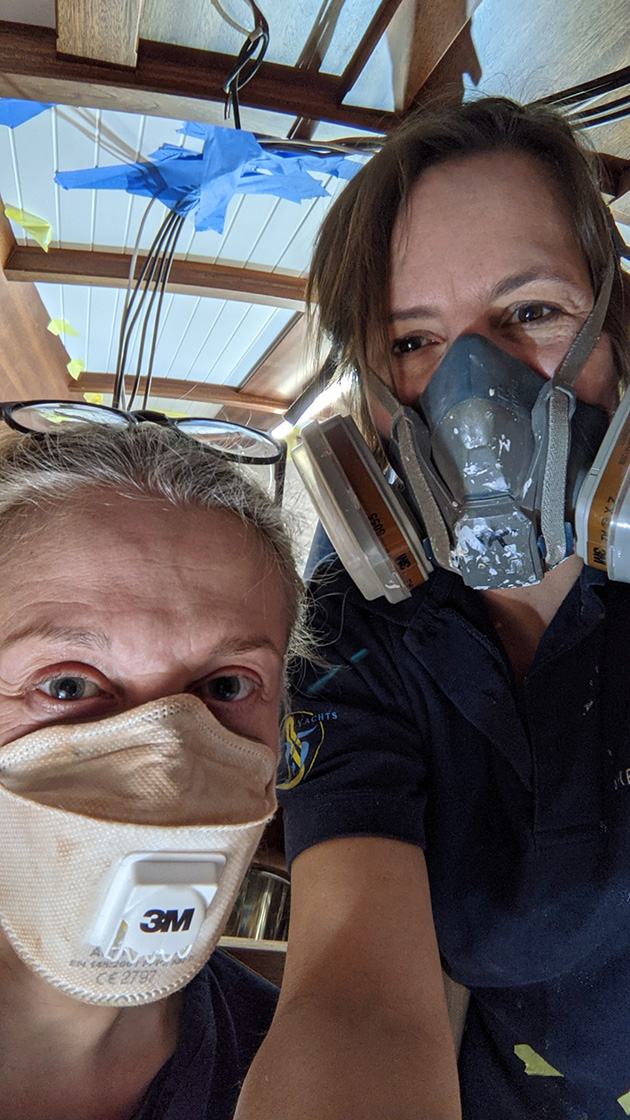
90% of those surveyed said they often wore incorrectly fitting PPE, which affected their ability to perform their job properly, including respiratory protective equipment. Credit: Belinda Joslin/Women in Boat Building
The test should be carried out annually, when the wearer initially receives a mask, if the wearer gains or loses 5% of their body weight, undergoes dental surgery, changes their job, changes their respiratory protective equipment or undergoes changes in their face, such as piercings, scars or other facial changes.
One respondent commented: “Even the XS RPE (extra small respiratory protective equipment) masks are too big for my face and never make a proper seal.”
Another said: “In boatyards, I’ve often found face masks and gloves are never provided in anything smaller than a size medium, effectively leaving me with oversized PPE or none. Also, small-sized face masks and ear defenders don’t account for [the fit] once all combined, so even when I can get size smalls by the time I have on mask, glasses and ear defenders there’s not space for them all to fit well. I often end up using noise-cancelling in-ear headphones rather than ear defenders just to free up space on my head!”
PPE guideline changes
The introduction of BS 30417 for the provision of inclusive PPE follows a campaign by Katy Robinson, who has spent years working in the construction industry. The senior project manager at East Riding of Yorkshire Council has long argued that PPE should fit workers correctly, regardless of their gender, ethnicity, religion or disability and wearing oversized or ill-fitting equipment is a health and safety issue.
“The launch of BS 30417 for the Provision of Inclusive PPE is a pivotal step for the campaigns that have been echoing across the construction industry over the last few years to bring about emphasis on the correct fit of PPE. In an industry where we have increasing diversity, it is vital that we work to ensure that everyone can work safely and comfortably, no matter their gender, ethnicity, religion, or disability,” she said.
Most BSI standards are voluntary technical guidelines which aim to promote best practice and quality, but can be legally enforceable if cited in legislation, mandated by regulation or included in commercial contracts.
Industry reaction
British Marine is the trade association of the UK’s leisure, superyacht and small commercial marine industry, with a paid-for membership. It issues guidance and best practice to its members about health and safety at work and the use of PPE to meet Health and Safety Executive (HSE) and COSHH regulations.
Its chief executive, Lesley Robinson said the findings of the Women in Boat Building survey were “clearly disappointing” and served “as a timely reminder that suitability, fit and proper assessment are not optional extras, even if PPE, like ear defenders, were not designed to be inherently gender-specific.
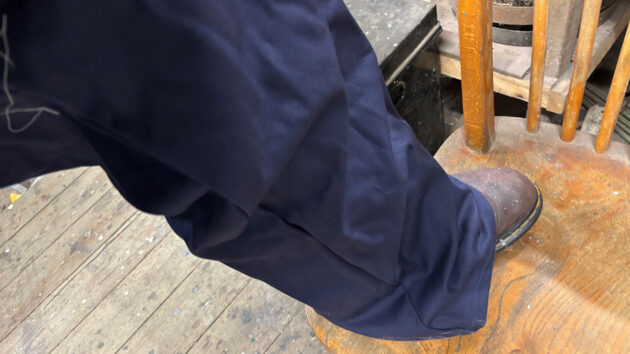
Over half of those who took part in the Women in Boat Building survey had experienced issues with ill-fitting overalls; many had to roll up excess fabric to prevent it from getting caught in machinery. Credit: Kaye Coyne
Robinson said British Marine is currently reviewing and updating its health and safety guidance for marinas and boatyards, which will continue to include reference to relevant HSE guidance and highlight the new BS 30417 standard when it is published next month; a review of its Boat Builders Guide is also planned.
“Suitability and fit are critical; even equipment that is not specifically designed for women must still be selected to properly protect the wearer. On the issue of face fit testing, whenever tight-fitting RPE is required under COSHH or other HSE-driven risk assessments, it is essential that it is correctly sized and face fit tested by a competent person. This does not necessarily mean a formally “certified” individual, but it must be someone with the appropriate training, knowledge and experience to carry out the test correctly. Without this, the effectiveness of the RPE cannot be assured,” she added.
Leave a Reply