Jester Challenge founder Ewen Southby-Tailyour and PBO’s Jake Kavanagh on the enduring appeal of this long-distance sailing event
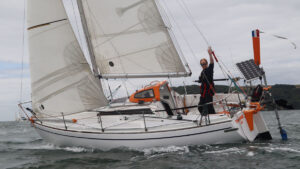
This year’s Jester Atlantic Challenge marks the 20th anniversary of the free-to-enter long-distance sailing event. The idea of The Jester Challenge is to allow ordinary sailors to undertake an extended single-handed voyage, but without big entry fees, scrutineering, sponsorship and razzmatazz. Indeed, the mantra for the Challenge has always been ‘Seamanship without showmanship.’
The boats taking part are usually mainstream production models, all under (or sometimes very slightly over) 30ft LOA, and usually run on a tight budget. Starting from Plymouth in the UK (with the Baltimore event having a simultaneous start from North Wales) the destinations alternate between Rhode Island in the US (2,790 miles) Praia de Vitoria in the Azores (1,300 miles) and Baltimore in Ireland (280 miles).
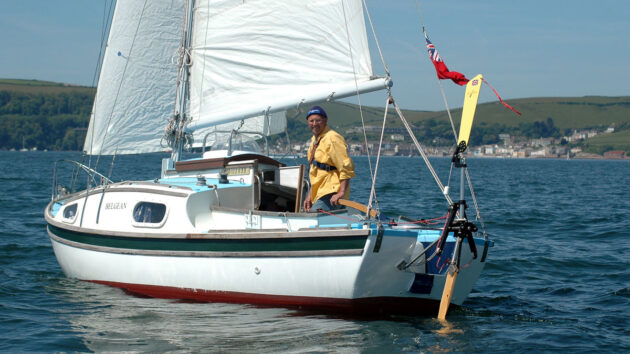
Even the smallest vessels are capable of long-distance voyages. This is Bill Churchouse in his 22ft Westerly Nomad, who took part in the first Jester Atlantic Challenge. Credit: Jake Kavanagh
As the skippers are facing a long off-soundings voyage, each hull is full of ideas to make sailing easy, safe and – depending on the weather – fun. Practical Boat Owner attended the first event in 2006, which saw 10 boats cross the start line in Plymouth Sound for the transatlantic voyage. Our coverage of the event, which saw seven retirements and three successful crossings, seemed to fire the imagination of our more adventurous readership.
Here, at last, was an event that anyone over 18 years old could enter, and with any sailing boat under 30ft. The whole Jester movement was spearheaded by military historian and former Royal Marine Ewen Southby-Tailyour, and he takes up the story from the firing of the start gun on Saturday, 3 June 2006.
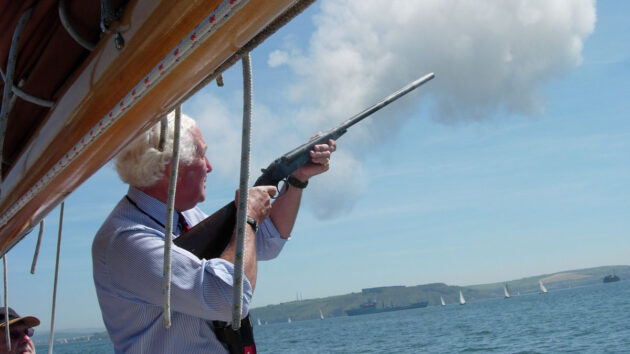
Founder Ewen Southby-Tailyour fires a 12-bore starting gun, both barrels filled with baby powder for a visible – and sweet-smelling – send off. Credit: Angus Southby-Tailyour
“At precisely 12 noon BST a large puff of baby powder was exploded across Plymouth Sound as both barrels of a 12-bore shotgun signalled the start of
the inaugural Jester Challenge,” he says. “Any competitor too close to the committee yacht, a 12-ton gaff cutter, would smell sweetly way out into the Atlantic. To understand the Challenge’s origins and popularity, we must go back to the summer of 1960. This was when Blondie Hasler’s ‘amazing idea’ for a single-handed race across the Atlantic was first sailed by five yachts, four of whom were under 25ft in overall length.
“Navigation was traditional and self-steering experimental, yet all reached Newport in good order. The first and, interestingly, the last time that this was ever to happen. However, so popular was the Observer Single-handed Transatlantic Race, or OSTAR as it became known, that by 1968 Hasler was worried the race’s success contained the seeds of its own death, with excessive competitiveness one of the reasons cited. Yachts of 128ft and 236ft in 1976 didn’t help the image.
“Fearing a demise, Hasler planned a considerably scaled-down ‘Series Two’ single-handed transatlantic race that, if necessary, would begin in 1980.
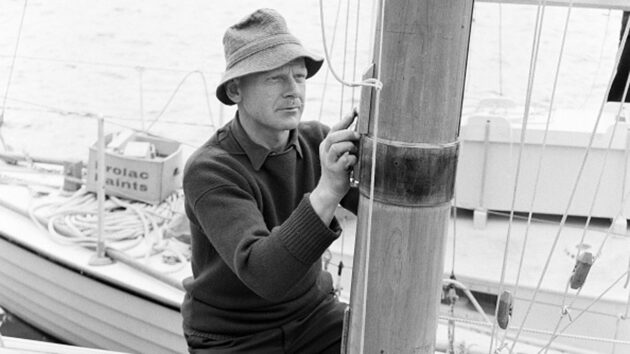
The original idea for solo ocean racing came from ‘Cockleshell hero’ Lieutenant Colonel HG ‘Blondie’ Hasler, the founder of the Special Boat Service. Credit: Getty
“Hasler’s ‘Series Two’ never occurred because the Royal Western Yacht Club (RWYC) was equally concerned that the OSTAR was becoming unmanageable. It saw it being swamped by professional organisations, so wisely hived off this professional element to Offshore Challenges. The RWYC then reverted to running a Corinthian event while reducing the lower limit to 27ft. A size restriction of 30ft had been introduced earlier, partly for administrative reasons, but primarily because of evolving international stability requirements which, although not banning the smaller vessels, made compliance difficult in formal events. The result, intended or not, excluded seaworthy yachts from a race that had at its very heart the 25ft Jester herself.’
“This ‘nautical nannying’ (emphatically not of the RWYC’s making) surprised the owners of Twisters, Folkboats, Contessa 26s, and even the diminutive Corribee 21’s who were suddenly disenfranchised from most recognised transoceanic races.
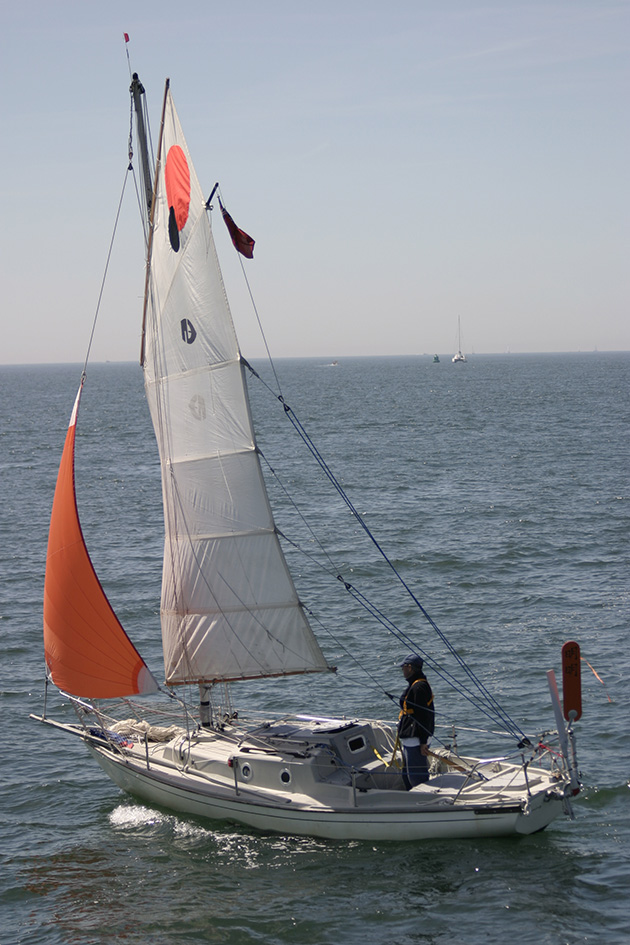
Roger Taylor’s famous Corribee 21 Mingming retired from the first event, mainly due to time constraints, but in later years made several engineless trips deep into the Arctic. Credit: Jake Kavanagh
“Experienced sailors know there is more to safety at sea than size and the righting moment of a displacement hull, for it is also a complicated matrix of human and physical factors. ‘The only arbiter of safety at sea is the sea itself,’ wrote Hasler, and ‘not a health and safety-orientated committee with slide-rules and copious regulations’.
“At that time Hasler believed, rightly as it turned out, that a higher percentage of under 30-footers would reach Newport, compared to larger vessels. Thus, it is also interesting to note that the only class in the OSTAR 2005 with no retirements was the Eira class of the smallest vessels.
“Another aspect of concern to the owners of under 30-footers was the entrance fee which, for the OSTAR 2020, stood at a colossal £1,800 (now £2,000+). Most Jester yachts are hardly worth that price and, anyway, their skippers would rather spend that sum on their vessels. “If size had not been a limiting factor, then the entrance fee most certainly now is, along with some safety regulations that are quite impractical to implement in such small vessels. The time limit to be an official finisher is currently at 40 days, unrealistic for those of Jester’s dimensions.”
The Jester Challenge is born
“So now we see the antecedents that necessitated the ‘inventing’ of a quirky, eccentric, rather British solution that would allow yachts under 30ft to compete on friendly terms with no entry fees, no time limit, no inspections and with negligible fuss. Instead, just a few guidelines and minimal interference.
“So was born a nautical challenge like no other; a contest that has at its heart what the Jester skippers have nicknamed a collection of ‘non-rules,’ yet a challenge that requires plenty of seamanlike decisions from a growing family of participants. I believe that the skippers alone, and not sponsors or nautical nannies, should bear the responsibility for what vessels they sail and what equipment they carry. Indeed, whether to sail or not.
“But why ‘Jester’? Following the loss at sea of the original Jester, a converted Folkboat, during the 1988 OSTAR a collection of friends formed the Jester Trust, of which I was also a member, to build a self-funded replica.
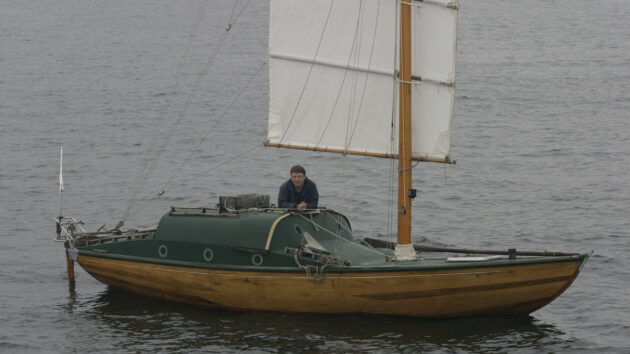
The Challenge is named after Blondie Hasler’s converted Folkboat, Jester. The original was lost at sea, but the faithful replica is seen here being sailed by her owner, Trevor Leek. Credit: Jake Kavanagh
“This would allow Michael Richey, who’d bought the vessel from Hasler, to continue taking part in the OSTARs. However, in 1997, after returning from the previous year’s contest, Richey celebrated his 80th birthday and grudgingly conceded that he was now too old for further transatlantic voyages, so Jester was put on the market.
“Her new owner would be Trevor Leek, an experienced OSTAR and Round Britain sailor who confirmed he’d leave her precisely as designed by Hasler.
“Once Trevor had taken possession, it was only right that we should plan a public future for a vessel that had been described in 1960 by the yacht designer, Angus Primrose, as ‘the only radical advance in yacht design this century’.
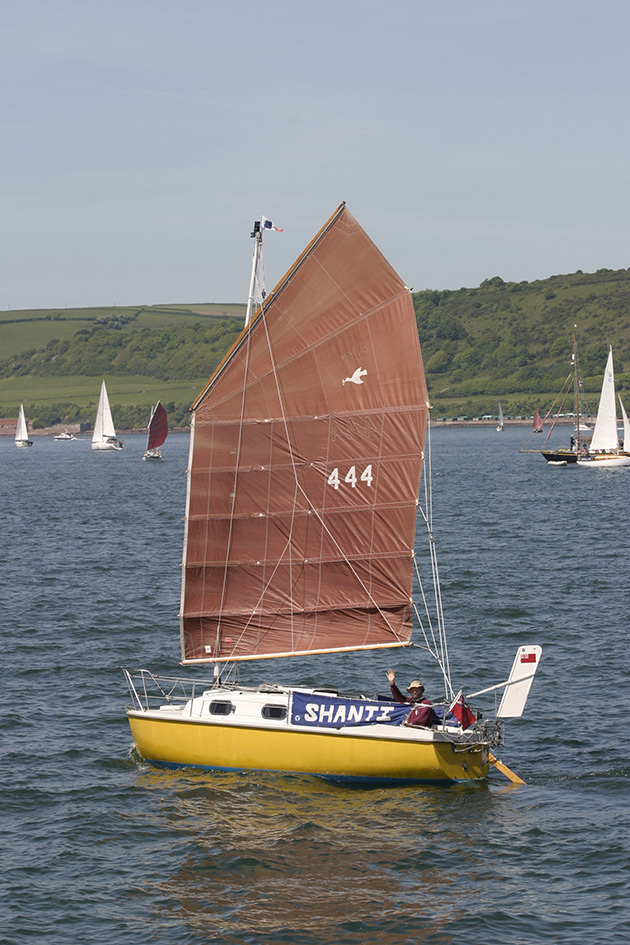
Pete Hill was one of only three finishers of the original 2006 Atlantic Challenge, sailing a very basic Kingfisher 22. Credit: Jake Kavanagh
“Then suddenly the solution was staring Trevor and me in the face: reinstate Hasler’s Series Two and let Jester herself lay down a challenge to cross the Atlantic. So, the Jester Challenge to Newport was born. It was, emphatically, not a race (for therein lay legal responsibilities for the ‘non-organiser’ – me) but a simple challenge between amateur skippers in similarly sized vessels. It would not be a ‘tournament’ between professional foes but a friendly contest (if one must use the description) between ‘family’ members.
“Having decided to lay down the Jester Challenge to all comers I thought it sensible to study and amend Blondie Hasler’s original ‘non-rules’ which, in part, were:
- The race will have no sponsor, no organising clubs, no rules, no official acceptance, no prearranged facilities of festivities at either end (I ignored that),
no entrance fee, no handicaps, no disqualifications, no race numbers, no official finishing order, no prizes and no official dinner. (I ignored that, too, on the understanding that such social occasions would help to bring together what I hoped would become a growing Jester family.) - Each skipper takes part in the race on his own responsibility as an ordinary seaman making an independent and legal passage.
- The design, condition, equipment and handling of the boat being entirely his own affair. No search and rescue operation will be mounted. Any skipper who is unable to remain alive by his own efforts is expected to die with dignity. (That last instruction was also ignored.)
“And so there we had Hasler’s reconstructed prototype, although from the beginning I felt that the need for informal festivities at both ends was fitting – and would happen anyway so why not make them part of the fun? They would also help to ‘bond’ a growing collection of international skippers with small vessels, little money, but limitless enthusiasm. With no public glory – and no sponsor – waiting at the finish, the highest standards of care tend to be exercised.”
Jake Kavanagh takes up the story: when the event press release arrived at the office PBO got involved, and I had the privilege of being sent to cover the 2006 start. The enthusiasm was infectious, and we could see the rich vein of content that could be useful to any boat owner sailing either short- or single-handed. We funded the burgees and encapsulated participant cards for future events, and made sure we got a journalist to every single one.

Eric Andlauer was the first to arrive on the 2006 crossing in his Beneteau First 21, using the latest navigation and weather-routing technology of the time. Credit: Jake Kavanagh
But as Southby-Tailyour was to discover, The Jester Challenge was not without its critics. “We had accusations in advance of needlessly calling on the emergency services,” he says. “Now, 20 years on, a lifeboat has only once been called out, and by a confused third party while the ‘distressed’ skipper herself was making her way to her destination in perfect safety. One yacht has foundered mid-Atlantic following a dismasting, with the skipper taken off by a passing merchant ship in a textbook rescue.”
“Sadly, in 2024, we had our first fatality with the loss of the highly experienced yachtsman Duncan Lougee on a warm, calm day during the Baltimore Challenge. The circumstances remain a mystery, and his body has not yet been found, although his drifting yacht was quickly recovered. There are bound to be further mishaps, but so far common sense and good seamanship have held the day. Compared to other events where keels fall off, crew are swept overboard, and vessels run
onto reefs (despite the most modern of navigational systems), we consider our record to be pretty enviable”.
An event for all
Now attracting young and old alike, and always warmly welcoming female skippers, the Challenge continues to evolve under the stewardship of the three-strong ‘Jester Helm.’
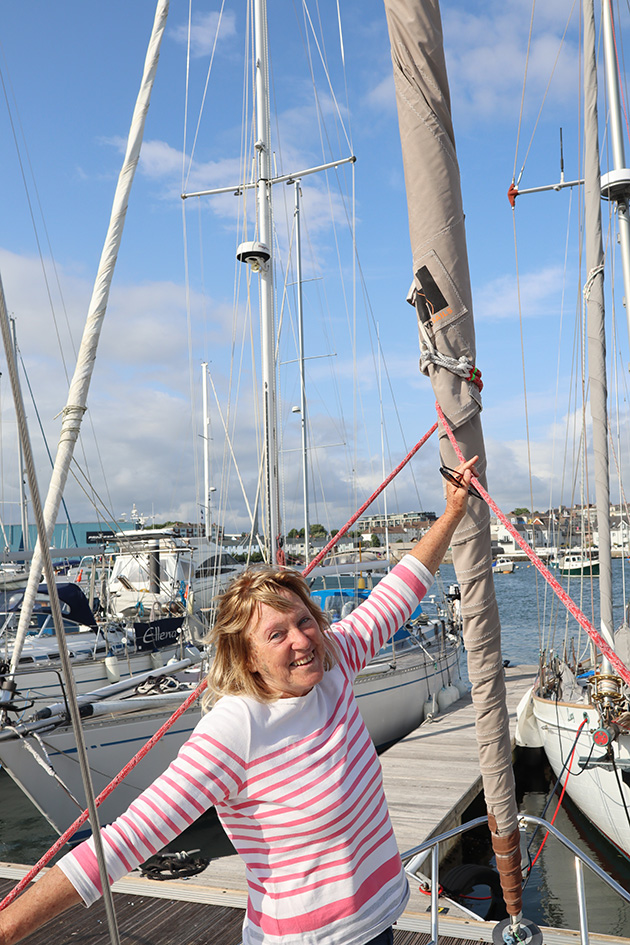
The Challenge is open to anyone over 18; Sue Denham competed in the 2024 Baltimore Challenge and is pointing to her shackle-free sheet attachments to the genoa. Credit: Jake Kavanagh
The next event will be the 280-mile Baltimore Challenge, with simultaneous starts from Plymouth in Devon and Phwelli in North Wales, timed to arrive
at the annual Baltimore Pirate Festival.
Summing up the Jester’s 20th anniversary, Southby-Tailyour writes: “We’ll carry on much as we have done so far, with no half-witted regulations, no financial charges and no unrealistic time limits. Instead, we will sail with the most amusing, adventurous, friendly and seamanlike skippers you could ever hope to meet.”
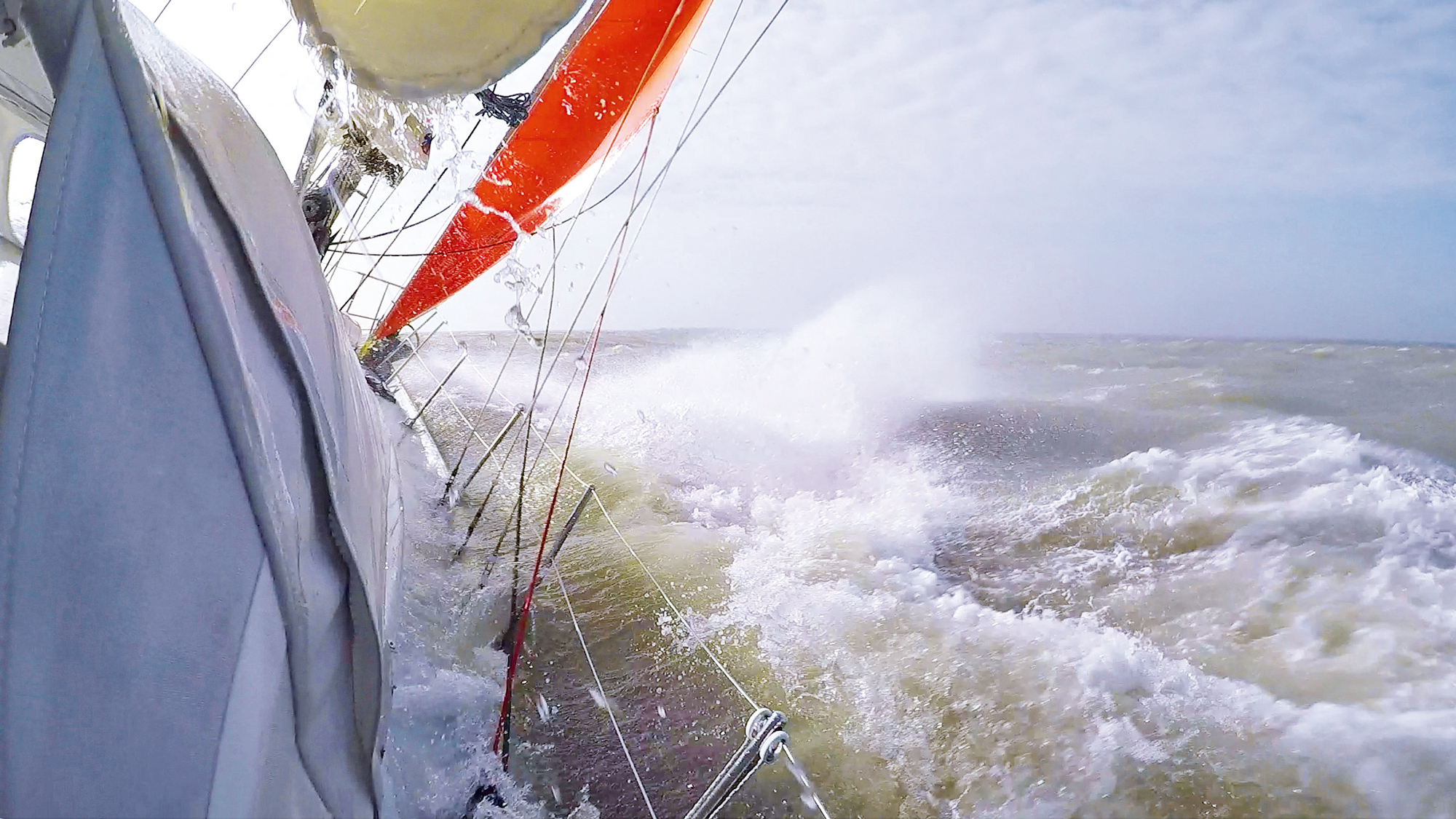
Preparing a small boat for heavy weather with advice from the skippers of the Jester Challenge 2025
The Jester Challenge 2025 once again proved a fertile ground for examples of how a short-handed crew can prepare for…

How to prepare a small boat for a big offshore sailing adventure: Top tips from Jester Challenge sailors
The art of sailing a small boat single-handed for long periods has been perfected by Jester Challenge sailors. Jake Kavanagh…
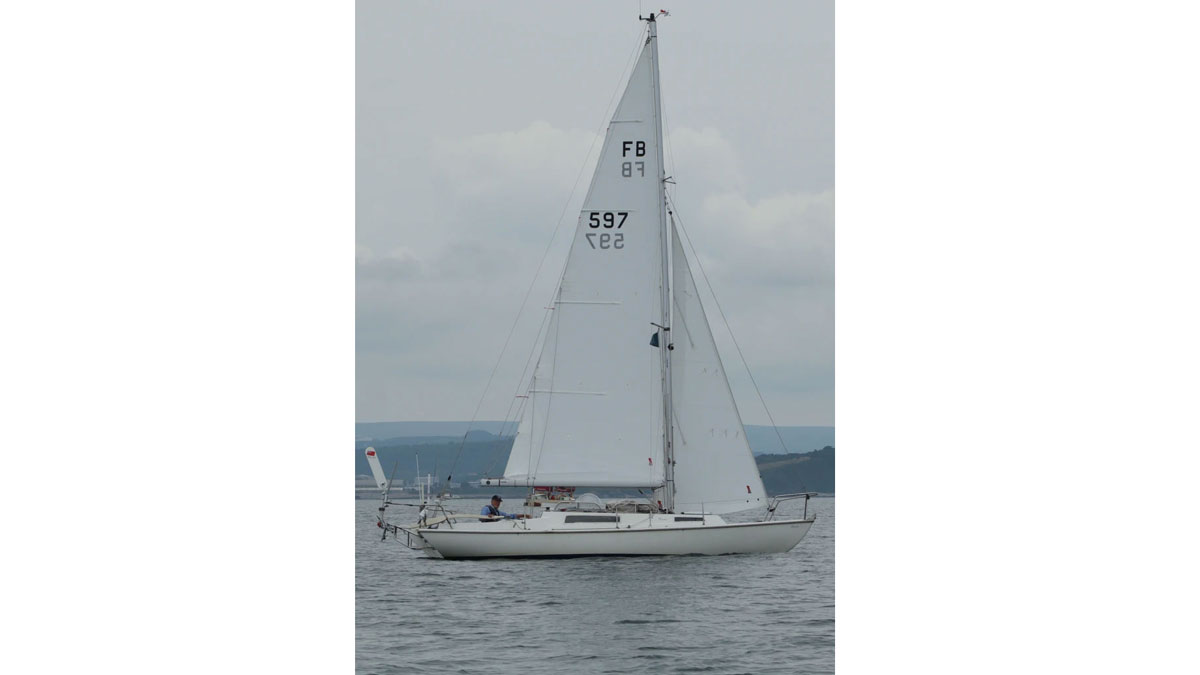
Jester Challenge folkboat Minke is found – but sailor Duncan Lougee is missing
A 25ft yacht that disappeared whilst sailing from Plymouth, Devon to Ireland as part of the Jester Baltimore Challenge fleet…
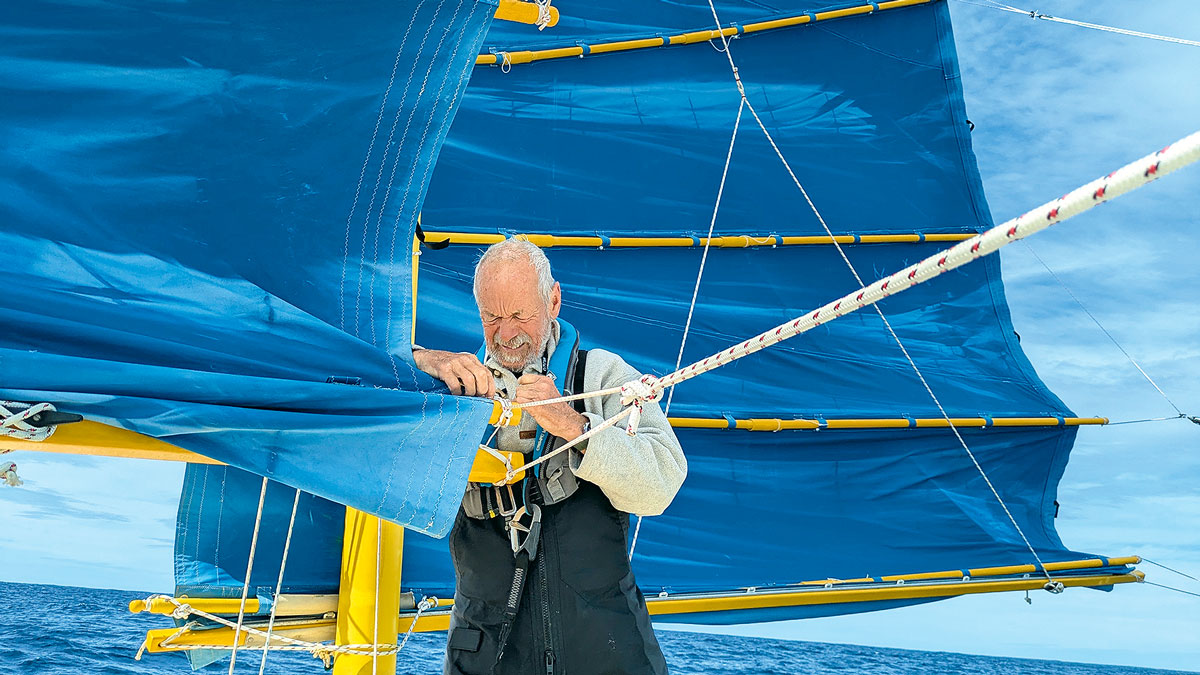
Pete Hill on sail repair, damaged steering and two lost drogues while battling storms in the Tasman Sea
Pete Hill faced damaged steering and lost two drogues while battling extreme conditions in the Tasman Sea. Graham Cox tells…
Want to read more articles like this?

A subscription to Practical Boat Owner magazine costs around 40% less than the cover price.
Print and digital editions are available through Magazines Direct – where you can also find the latest deals.
PBO is packed with information to help you get the most from boat ownership – whether sail or power.
-
-
-
- Take your DIY skills to the next level with trusted advice on boat maintenance and repairs
- Impartial, in-depth gear reviews
- Practical cruising tips for making the most of your time afloat
-
-
Follow us on Facebook, Instagram, TikTok and Twitter