Thousands of coastguard rescue officers (CROs) will no longer be paid for emergency call outs or for undertaking training exercises, from September 2026, following a decision by the Maritime and Coastguard Agency (MCA).

More than 3,500 CROs around the UK’s coast make up the bulk of the Coastguard Rescue Service (CRS), the volunteer arm of HM Coastguard, which is responsible for all rescues around sea-born cliffs.
Other responsibilities include beach searches for missing people, flood rescues, assisting with confined space rescues inland where the fire service does not have the kit, and body retrieval.
As the 4th emergency service, HM Coastguard plays a vital role, and CROs who leave their jobs at a moment’s notice to serve, have long been able to claim around £11 an hour or a minimum of £33 for call outs.
A #SaveOurService campaign has been launched by Scottish CRO Dr Kelly Stockdale in response to the MCA’s proposed ‘revised volunteer model’ and only allow out-of-pocket expenses, which could “hit people hard”.
Today, the topic of ‘HMRC guidance and remuneration of coastguard volunteers’ was subject to a Westminster Hall debate.
The shake-up follows a six-year legal battle with former CRO Martin Groom from the Isle of Wight, who – upset by being dismissed from the volunteer role he had served in for 35 years – set about to prove that CROs were ‘workers’, not volunteers – and won.
As a result of the judgment –and subsequent Court of Appeal decision to uphold it in January this year, the MCA has proposed a new model for volunteer CROs, which does not include hourly remuneration.
Parliamentary Under-Secretary at the Department for Transport (DfT) Keir Mather has accepted the recommendation, and plans, announced in June, will take affect this September.
What happened?

A six-year legal battle by former station officer Martin Groom has had huge repercussions for the UK Coastguard. Credit: Martin Groom
In May 2024, the Employment Appeal Tribunal issued a judgment (Groom v MCA) which determined that the former CRO was a ‘worker’ in circumstances when he was carrying out a remunerated activity.
This overturned the previous decision by an Employment Tribunal in 2022.
In January 2026, the Court of Appeal upheld the judgment that CRO’s are ‘workers’ in circumstances where they are carrying out a remunerated activity.
This would give CROs to some employment rights, such as paid holiday and the National Minimum Wage (£12.71 per hour for over 21s).
Huge repercussions

Martin, when he joined the Coastguard Rescue Service at Bembridge, Isle of Wight, aged 18. Credit: Martin Groom
Martin Groom told PBO he had hoped his case would improve CRO rights as workers, but fears the new MCA stance will deter people from the service.
Joe Robertson, MP for Isle of Wight East, agrees. In an open letter to MCA chief executive officer Virginia McVea, he said: “Aside from the insult to our brave men and women working on the front line 24 hours a day, 365 days a year, the whole Coastguard as we know it is at risk of collapse as CROs understandably decide to call it a day.
“Further recruitment, which was already challenging, will simply dry up.”
He added: “Having decided not to seek to appeal this decision to the Supreme Court, the MCA should have ensured that it changed its out-of-touch practices to properly recognise the status these brave men and women working on the front line deserve.
“Instead, the MCA has announced that it will strip CROs of the modest remuneration they receive, while continuing to require them to attend mandatory training, around 90 hours including casualty care, search and water rescue, skilled rope rescue and mud rescue, and turn up to on-call emergencies.
“This decision is akin to a ‘fire and rehire’ of workers as volunteers.
“It is deeply disrespectful, and frankly staggering, that the Maritime and Coastguard Agency, a public body under the Department for Transport, has decided to act in this way.”

The Coastguard Rescue Service, the volunteer arm of HM Coastguard, is responsible for all sea-born cliff rescues. Credit: Joan Gravell/Alamy
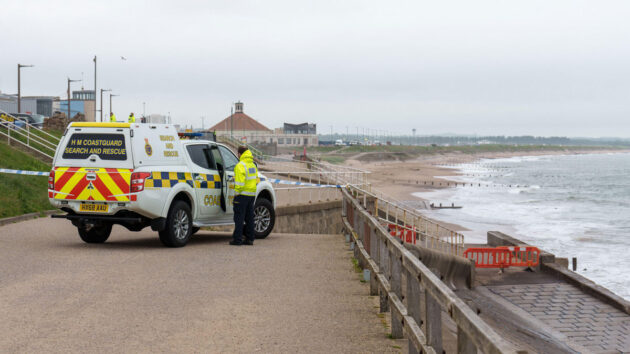
Cordoning off beaches due to suspected unexploded bombs is among the varied tasks CROs may be expected to undertake. Credit: JASPERIMAGE/Alamy
New model reasons
An MCA spokesperson said: “After careful consideration, we are moving the Coastguard Rescue Service to a revised volunteer model, to best protect the future of the service.
“This decision follows a legal judgment, which means we need to change how the service operates.
“This is not something we wanted to do but is a consequence of the Court of Appeal ruling.
“This new model protects choice, flexibility and the ability for people to volunteer alongside their primary employment.
“We deeply value and recognise the significant service Coastguard Rescue Officers provide along our coastline, and we will be supporting them during this transition.
“The Coastguard Rescue Service will continue to maintain a robust, effective search and rescue response, ensuring the highest quality of service and levels of safety.”
Trade union support for the #SaveOurService campaign

A UK Parliament motion for Coastguard remuneration has received the backing of 40 Members of Parliament
Dr Kelly Stockdale, a CRO in Berwickshire, Scotland, is spearheading the #SaveOurService campaign.
In a statement, the campaign team said: “Every single day, across 19,000 miles of complex UK coastline, CROs answer the shout.
“We leave our families, our beds, and our primary jobs to descend cliff faces, brave rising floodwaters, and track missing and vulnerable persons in all weathers, at all times.
“We are not casual, fair-weather hobbyists. We are highly trained, safety-critical emergency responders.
“As a Category 1 emergency service, we work alongside the police, fire, and ambulance services.
“Yet, while every other blue-light service remains funded, HM Coastguard is uniquely being degraded.”
Lynsay Mackay, of GMB Scotland, said: “If we want a strong, resilient Coastguard for the future, we must make sure that those who step forward are supported, not penalised.
“If you save lives, you deserve respect. If you carry out work, you deserve rights. And when those rights are threatened, GMB stands with you.”
Start of season boaters’ checklist
As excitement builds for the new sailing season, minimise the risk of shakedown cruise glitches and common mistakes with this…
Coastguard warning after two yachtsmen spark multiple rescues
“It’s not of role the UK Coastguard, which is an emergency service, to arrange a vessel’s repairs or to move…
Meet Julie-Anne Wood, the highest ranked woman in Her Majesty’s Coastguard
The new Head of Maritime Operations, Julie-Anne Wood, has made history as the first woman to achieve this rank in…
Want to read more articles like ‘UK volunteer coastguard under threat’?

A subscription to Practical Boat Owner magazine costs around 40% less than the cover price.
Print and digital editions are available through Magazines Direct – where you can also find the latest deals.
PBO is packed with information to help you get the most from boat ownership – whether sail or power.
-
-
-
- Take your DIY skills to the next level with trusted advice on boat maintenance and repairs
- Impartial, in-depth gear reviews
- Practical cruising tips for making the most of your time afloat
-
-
Follow us on Facebook, Instagram, TikTok and X