Our visit to iconic pirate radio station Radio Caroline takes you behind-the-scenes onboard the Ross Revenge, the last radio ship still broadcasting offshore. (Spoiler: you can visit now, too!)
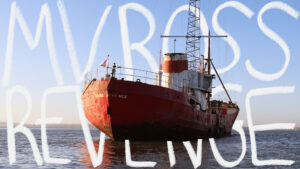
Some miles off the Essex coast, inside the bright red skeleton of an old Icelandic fishing trawler, lives a radio.
Radio Caroline is the last of its kind. For 62 years the iconic pirate radio station, now fully licensed, has weathered storms, tightening broadcast regulations, the occasional police raid, funding challenges, and changing technologies even when other offshore broadcasters folded.
Its current home is equally singular.
As the last surviving offshore radio ship, Ross Revenge is a portal back to the heyday of pirate radio immortalised in the 2009 Richard Curtis film The Boat that Rocked.
It hosts a timeline of defunct broadcasting technology, not to mention a present-day office of sorts. It’s also the last example of the distant fishing fleet, and an artefact from Britain’s Cod Wars with Iceland.
The result is a living, floating museum of maritime and radio history and feats of human engineering, and an unexpected symbol of rebellion, reinvention, and human ingenuity.
And now, you can visit firsthand. Ross Revenge has welcomed its latest guise: weekend destination.
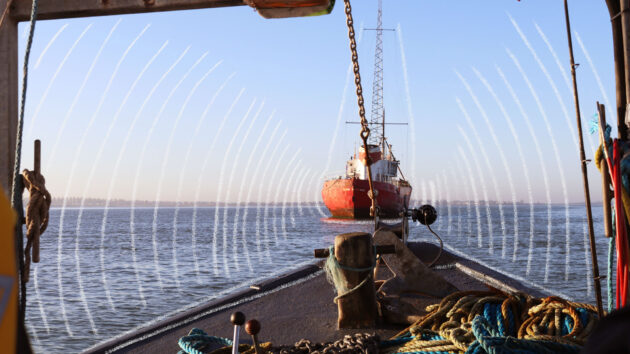
Approaching Ross Revenge on the way out from the West Mersea pontoon. Credit: Viveka Herzum.
In its latest chapter, Radio Caroline has opened its doors to visitors to raise funds for the ship’s upcoming dry dock restoration.
The tours are guided by volunteers, many of whom were on air on Radio Caroline in the 1980s, when the station broadcast 24 hours a day to an audience of millions.
Weaving between old transmitters, shelves of records, buckets of tools, and the odd photo of jeans strung up to dry in the engine room, Radio Caroline’s seasoned disc jockey’s share the vessel’s history with a wistful enthusiasm.
Ross Revenge is both their haven and their home. With water all around you and music playing in every corner, you’re not so much visiting a place as an atmosphere. The groove floats into the engine room, through the broadcasting suites, the cabins, anywhere you turn above and below deck.
‘I guess this is why we still do these things. It’s like the turtle instinct,’ explains presenter Ray Clark of the labour of love required to keep the music (and the lights) on. ‘This is where we live. We went off and did other things. It’s payback time now.’
‘As somebody famous said, you can check out anytime you want, but you can never leave.’
Boarding Ross Revenge
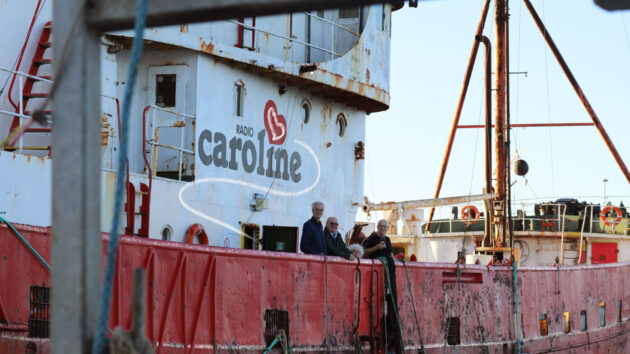
Radio Caroline volunteers onboard Ross Revenge. Many have been involved with the station since the 1980s. Credit: Viveka Herzum.
‘The reason why people still talk about Radio Caroline, why it was such a revolution, is that it was the first time the BBC’s monopoly had ever been broken. Suddenly, there was something different to listen to,’ presenter Peter Philips explains.
Along with contemporaries like Radio Northsea, Radio Veronica, and Radio London, Radio Caroline originally operated as a “pirate” radio station.
‘Pirate’ not in the swashbuckling sense, but because these independent, underground stations would skirt licensing rules and fees by broadcasting from ships anchored outside of territorial waters,’ Philips says.
The record companies and the PR agencies, ‘They were bigger pirates than we were. As is always the case, it’s not the performers and the artists but the companies that control them that get the lion’s share of the money.’
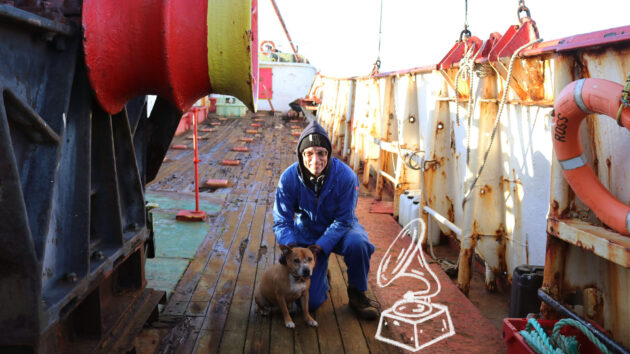
Engineer John Pryke with the ship’s dog, Bella. Credit: Viveka Herzum.
At the time of Radio Caroline’s founding, the territorial limit was just three miles out from the coastline. With the Territorial Sea Act of 1987, this became 12.
A chart kept onboard documents the positions of every offshore radio station that has broadcast off the British Isles in the last 60 years, tracing their gradual move away from shore.
After the limits were redrawn to incorporate any drying sandbank into the British mainland, Radio Caroline itself ended up in deep water almost 20 miles off of Margate.
While these days it anchors a little closer to shore, it’s still over a half hour from the pontoons in West Mersea on the Ross Revenge tender, a small fishing boat called Aspire.
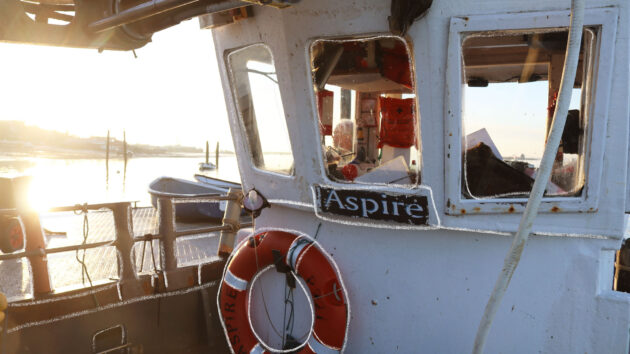
Ross Revenge’s tender Aspire waiting for visitors at the West Mersea pontoon. Credit: Viveka Herzum.
Before Ross Revenge, Radio Caroline had MV Frederica (1964-1968), Cheetah (1966), and Mi Amigo (1964-1968 and 1972-1980), which went down in 1980 in the North Sea with a boat full of (quite valuable) records. Apparently they’re still there, sealed up and silted over.
Radio Caroline’s team at the time, which included founder Ronan O’Rahilly, searched in fishing towns like Hull and Grimsby for a suitable substitute.
They eventually found Ross Revenge in Scotland. With a reinforced bow strong enough for breaking ice in Icelandic waters and a stable build that could take the monumental mast needed for broadcasting, the 219 ft Icelandic super-trawler fit the bill.
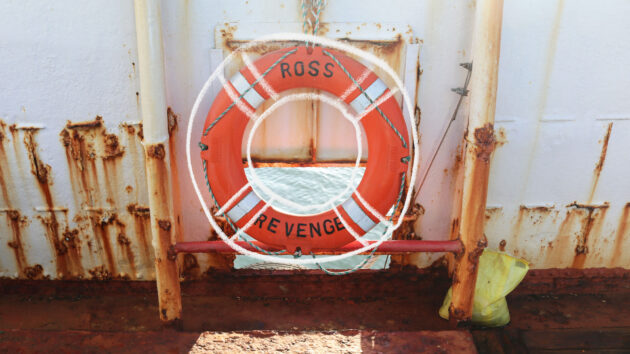
Before it became a pirate radio ship, Ross Revenge was an Icelandic super-trawler. Credit: Viveka Herzum.
Ross Revenge was no everyday fisher. Once ‘the Rolls Royce’ of the distant fishing fleet, it still holds a world record, never to be broken, for the largest catch of cod ever landed. (Today, the presenters specify, it would be banned from fishing at all on environmental grounds.)
It had survived the end of the Cod Wars, which brought the scrapping of many vessels of its kind. Greenpeace’s first Rainbow Warrior, another converted fishing trawler that would be bombed and sunk by French Secret Service agents in 1985, was one of few other survivors.
After Ross Revenge was acquired for Radio Caroline, a refit in Santander, Spain turned this high-performing trawler into a ship fit for radio.
Refitting Ross Revenge for radio
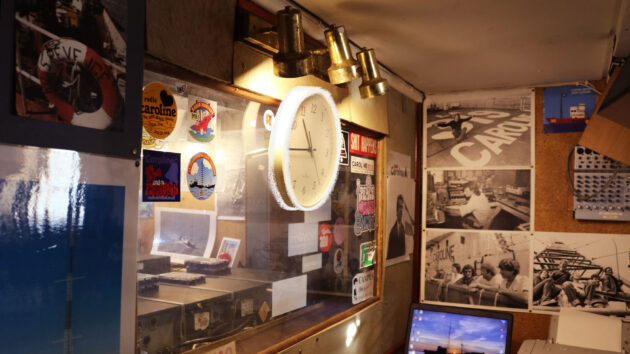
Inside the Radio Caroline recording booths. Photo: Viveka Herzum.
‘Offshore radio stations don’t just happen,’ says Clark. ‘They have to be thought through. It’s not like an onshore station where you can just plug it into the mains. Here you have to have everything in one place.’
Much of the fishing equipment on Ross Revenge was scrapped to make way for broadcasting equipment, though traces of the boat’s previous life as a trawler remain in the occasional warp and pulley, the flanges that created stalls for the catch, an engine room still labeled in Icelandic, and the breach visitors are encouraged to whistle into.
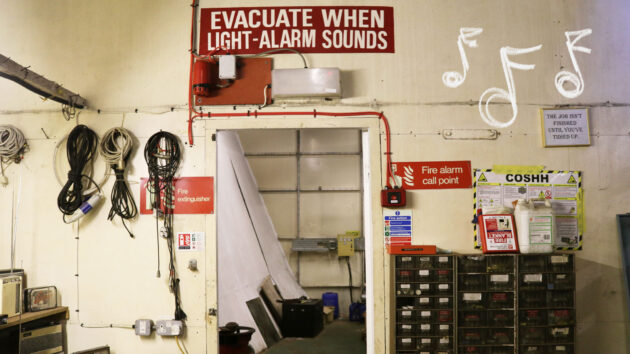
Photo: Viveka Herzum.
The ‘fish room,’ where fishermen would tip cleaned catch, now houses decades worth of radio broadcasting equipment. A 50 kilowatt transmitter, which would be about the size of a fridge freezer if made today, takes up most of the hold.
‘You look at the equipment around here now, and sadly, it looks as if it wouldn’t be out of place in a scrap yard,’ Clark says. ‘But it was so impressive 30, 40, years ago, when it was first put there.’
These transmitters were less efficient than a modern solid state transmitter, and would’ve required about a ton of diesel a day to stay powered. As with all food, water, records, and other provisions, this fuel had to be regularly taken out to the ship.
‘It’s a feature of offshore radio ships that you can take them out to sea, but you can never take them back in again,’ Clark says. ‘If you do, they’ll get seized. So they just sit out at sea until they sink.’
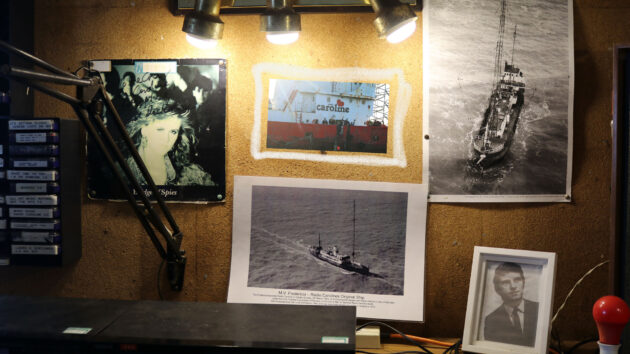
Photo: Viveka Herzum.
To stay safe, self sufficient, and fit to broadcast, the Ross Revenge required plenty of creative problem solving and engineering ingenuity, much of which was contributed by Radio Caroline’s engineer of 20 years, Peter “Chicago”.
To penetrate most of Europe, Chicago wanted a quarter wave aerial to broadcast on 963 kilohertz, requiring a mast about 285 feet tall.
With all its rigging, the iconic ‘300ft’ mast weighed 19 tons. It was welded to the hull, reinforced with three legs, and enclosed in a cage to avoid any possible contact with the electrical current in rough seas.
Volunteer / Presenter Nick Carter pulls up a photo on his phone, which shows a mast several times the length of the ship. On a cloudy day, he says, its top would disappear right into the clouds.
To counter this height and the sheer weight of the thing, Chicago had 200 tons of concrete poured into the hull as ballast. He also put in a diplexer, which allowed Radio Caroline to broadcast two high powered signals from the ship at the same time.
‘There must’ve been a lot of confused dogs around in the 80s,’ Clark laughs. ‘Maybe they could hear both services.’
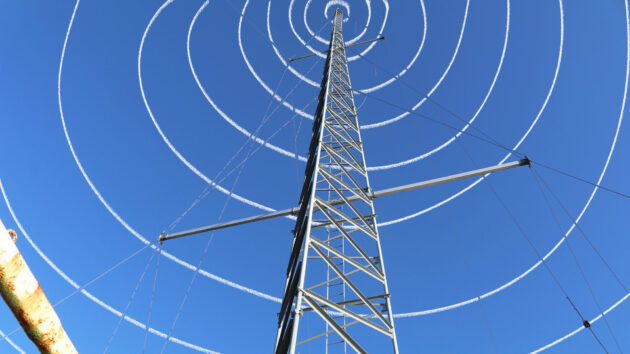
Ross Revenge’s current mast is 100m, a third of the original size. Credit: Viveka Herzum.
The colossal mast came down after a series of storms, during which it sustained significant damage to its insulators.
‘Any other ship would have gone into port and replaced them,’ Clark explains. ‘But of course, we couldn’t.’
Its successor was a more conservative 100ft tall installation with decreased broadcasting capacity.
Radio Caroline today
Mast aside, the rest of the broadcasting equipment onboard is original and fully functioning.
While most of it isn’t in use anymore, it’s still an integral part of Radio Caroline’s history, as well as a unique snapshot of how radio broadcasting equipment developed across decades.
The Ross Revenge currently has three working studios, one of which is still setup to broadcast in mono. The rest have been refurbished with modern equipment for Radio Caroline’s two regular broadcasts, which use mobile phone technology.
The additional monthly Caroline North broadcasts are linked to the Isle of Man Max radio and hosted live, often during boat tours, by the very disc jockeys who worked on Radio Caroline in the 80s.
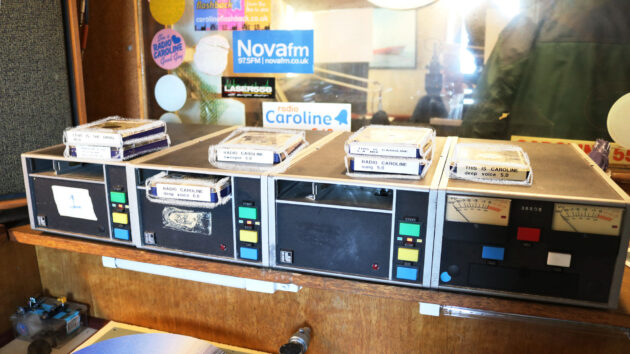
One of the studios on Ross Revenge can still broadcast in mono. Visitors are invited to try out some of the technology. Credit: Viveka Herzum.
They remember their earlier broadcasting trips, which could last anywhere from 6 weeks to 6 months, with a pandora’s box of personal stories full of colourful details about smuggled tapes, secret codes used to communicate over the radio, and records getting chipped from landing on the floor in rough seas.
‘You see the sea in the sky, and see the sky, and then you feel a bit queasy, and you look out the back, and start doing a figure eight and you think, why am I out here?’ Clark laughs.
He adds that the challenge of, ‘Physically picking up a piece of vinyl and putting the needle on the vinyl was not always easy. In a rough sea, you probably went through a few needles.’
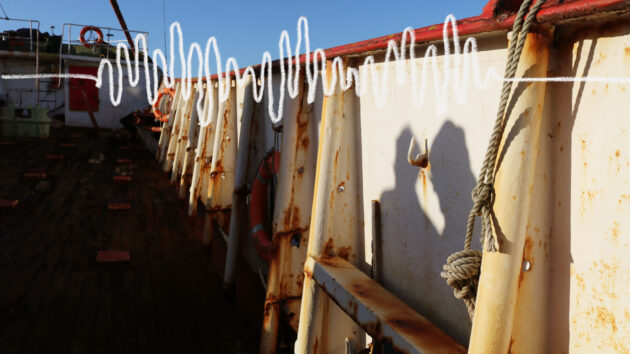
Photo: Viveka Herzum.
The future of Radio Caroline
As the last surviving offshore radio ship and one of the last examples of the distant fishing fleet, Ross Revenge packs a lot of maritime and radio history into one hull.
It’s now owned by a trust, which aims to get the ship into dry dock.
They are particularly worried about the valves in its sea chest, which they haven’t been able to inspect in a while, and intend to attempt getting its seized engine, a 10 cylinder turbocharged Dutch built ship’s engine, back into action.
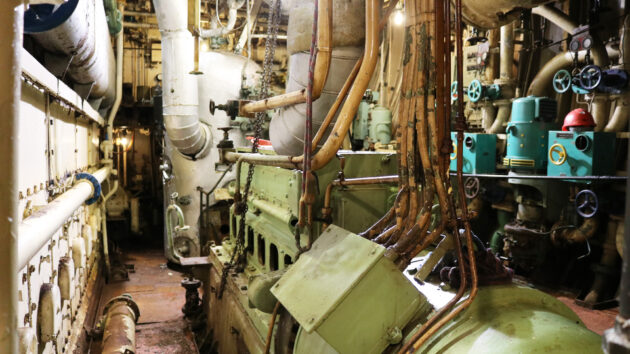
The engine room on Ross Revenge, which hosts a seized 10 cylinder turbocharged Dutch built engine. There is only one other like it in the world, preserved in a tug boat in Amsterdam. Credit: Viveka Herzum.
Yet the people who would be able to understand how the engine works and get it running are dwindling.
Like much of the maritime industry and many hobby industries alike, Radio Caroline is facing a succession problem. Ross Revenge will need a new influx of volunteers, broadcasters, and ship’s engineers to keep it not only operational, but out on the water.
For now, financing the dry dock is the most urgent part of ensuring Radio Caroline’s future. You can help by visiting, donating directly to the charity’s Crowdfunder, purchasing merch in their online shop, and, of course, by listening, either online or through the app.
It will be the music, and the community’s continued passion for it, that keeps the spirit of Radio Caroline afloat.
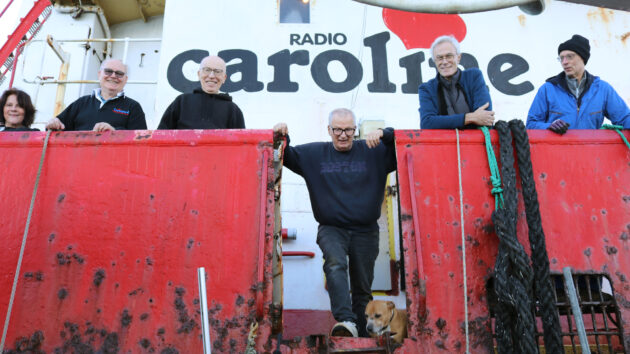
(LEFT TO RIGHT) Boat trips organiser Paula Shaw, presenter Ray Clark, presenter Nick Carter, presenter Johnny Lewis, presenter Peter Philips, engineer John Pryke. Credit: Viveka Herzum.
Want to read more articles about Radio Caroline?

A subscription to Practical Boat Owner magazine costs around 40% less than the cover price.
Print and digital editions are available through Magazines Direct – where you can also find the latest deals.
PBO is packed with information to help you get the most from boat ownership – whether sail or power.
-
-
-
- Take your DIY skills to the next level with trusted advice on boat maintenance and repairs
- Impartial, in-depth gear reviews
- Practical cruising tips for making the most of your time afloat
-
-
Follow us on Facebook, Instagram, TikTok and Twitter