Coastguards Rescue Officers across the United Kingdom are celebrating ‘a huge win’ in their campaign to stop their pay being cut.

Minister for Transport Keir Mather announced in parliament today that the Maritime and Coastguard Agency (MCA) plan to stop hourly remuneration for attending incidents and training exercises would be halted.
In a statement, he said: “I would like to begin by recognising the extraordinary contribution made by Coastguard Rescue Officers (CROs) across the United Kingdom.
“For generations, HM Coastguard’s coastal response has depended on people from local communities who choose to serve with professionalism, commitment and courage.
“That tradition remains at the heart of the Coastguard Rescue Service (CRS) today.
“On 14 January 2026, the Court of Appeal found against the MCA in the case of the MCA vs Groom.
“This clarified that by providing modest remuneration, the MCA had inadvertently created a worker relationship with CROs.
“A change was therefore required to restore the volunteer model, or enact the worker model, to ensure compliance with the judgment.”

Former CRO Martin Groom, upset by being dismissed from the volunteer role he had served for 35 years, set about to prove CROs were ‘workers’ not volunteers – and won. Credit: Martin Groom
On 1 June, the CRS was told that it would be changed to an expenses-only volunteer model from September 2026, prompting a #SaveOurService campaign, which has attracted more than 121,975 signatures of support.
Mr Mather said: “This was judged at the time to be the best option, based on the advice provided by the MCA, taking into account a variety of factors.
“I have listened to the views and testimonies of CROs about how these changes might affect them.
“I visited a Coastguard station in Southampton, met officers from Hill Head and Portsmouth teams, and heard first-hand the impact that changes could have on CROs and their families.
“MPs across the House, on behalf of their constituents, have raised concerns through parliamentary questions, a Westminster Hall Debate and an Urgent Question.
“This engagement has been invaluable.
“I have also heard the deep concerns from many in the CRO community about this change.
“Given these concerns, my department has undertaken further work to scrutinise the information that was provided to inform decision making.
“Having done so, it has become clear that parts of the information gathering process to inform MCA operational decisions, in particular, the two surveys undertaken, were not sufficiently detailed to properly reflect the impact of these changes.
“I can therefore confirm that plans to move to the expenses-only volunteer model in September will not go ahead, and current arrangements will remain in place.”
What will happen now?

More than 3,000 CROs around the UK’s coast make up the bulk of the Coastguard Rescue Service (CRS), the volunteer arm of HM Coastguard. Credit: Marcin Rogozinski Zwei/Alamy
Over the coming months, the MCA has pledged to engage further with trade unions, CROs, and MPs, ‘to understand more deeply the potential impact of changes on individuals and operations’.
Mr Mather added: “The insight gathered from this engagement will support the MCA’s understanding of operational implications, and inform future decisions on the shape of the CRS.
“In the longer term, the Department for Transport will explore options for how CROs can continue to be rightfully recognised and rewarded and have the flexibility to continue to serve their communities.”
As one of the four frontline emergency services, HM Coastguard plays a vital role. Credit: Marcin Rogozinski Zwei/Alamy
What does the Coastguard Rescue Service do?
More than 3,000 CROs around the UK’s coast make up the bulk of the CRS, the volunteer arm of HM Coastguard, which is responsible for all search and rescue activity around the coastline of the UK.
This activity includes mud rescues, shallow water, and some flood rescues, cliff rescue and assisting police with coastal searches for missing people.
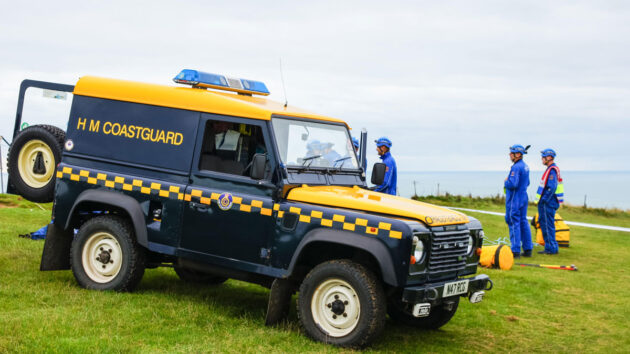
As one of the four frontline emergency services, HM Coastguard plays a vital role, and CROs currently receive £12.21 per hour for operational duties, including training attendance.
The #SaveOurService campaign, launched in response to the MCA’s revised volunteer model to allow only out-of-pocket expenses, and Martin Groom’s landmark court case, have been supported by GMB Union.
Nicola Savage, GMB National Officer, said: “This is a richly deserved win for GMB’s coastguards, who took their campaign across the UK and into the corridors of power.
“It was a scandal that these brave, life-saving workers would have their pay cut.
“But Ministers have listened and done the right thing.”
UK volunteer coastguard ‘under threat’
Thousands of coastguard rescue officers will no longer be paid for emergency call outs or training exercises following a Maritime…

Couple saved from cliffs after yacht hits rocks
A man and woman were rescued yesterday morning after their 47ft yacht was blown onto rocks in Swanage

“I worried the mast might strike the rotor blades” – helicopter rescue from sailing boat
Talan Skeels-Piggins experiences a medical emergency in rough seas while attempting to sail around Britain in his Colvic UFO 34
Want to read more articles like ‘Volunteer coastguard win celebrated as pay cut plan paused’?

A subscription to Practical Boat Owner magazine costs around 40% less than the cover price.
Print and digital editions are available through Magazines Direct – where you can also find the latest deals.
PBO is packed with information to help you get the most from boat ownership – whether sail or power.
-
-
-
- Take your DIY skills to the next level with trusted advice on boat maintenance and repairs
- Impartial, in-depth gear reviews
- Practical cruising tips for making the most of your time afloat
-
-
Follow us on Facebook, Instagram, TikTok and X